

To many readers, these passages are easy to skim. To a new generation of entrepreneurs, however, they are something else entirely: an untapped design manual.
Across dining room tables, classroom desks and living room floors, ancient sacred sites are being rebuilt—brick by interlocking brick. Lego-compatible construction kits inspired by the ancient temples and sanctuaries are transforming scripture into something tactile, visual and surprisingly fun. And they are finding a ready audience, too.
“The goal is to inspire [Jews] to be more religious and to be more connected.”
One notable success story belongs to Sean Sutton, whose crowdfunding campaign for a Wilderness Tabernacle building set raised more than $245,000, far exceeding expectations. The set includes a tent-like sanctuary, miniature furnishings, a high priest figurine and even tiny tablets of the Ten Commandments—all rendered in modular plastic.
“A lot of us grew up with Legos and understand how fun they are,” Sutton said. His idea took shape after watching children and young adults at a Bible camp recreate the Tabernacle described in Exodus. “People are hungry for high-quality religious sets,” he said—and the response he received proved him right.
Sutton’s project is part of a growing galaxy of faith-based builders who see religious history not as static text but as something that can be assembled and explored. Brick’Em Young—a company whose name is a play on its faith’s second leader, Brigham Young—offers detailed models of Church of Jesus Christ of Latter-day Saints temples. Muslim Blocks produces Lego-style kits depicting Islamic landmarks like the Kaaba in Mecca and Istanbul’s Blue Mosque.
Each project blends reverence with play and education with creativity while retaining a commitment to authenticity. Designers consult biblical passages, historical scholarship and architectural research to ensure their models are faithful representations. The precision once crystallized in parchment is now thus brought to modern life courtesy of colorful pieces that snap together effortlessly.
Perhaps the most ambitious example comes from Geulah Products, founded by Paul “Shlomo” Helinski, an Orthodox Jew and father of eight who bonded with his children over Lego-building sessions. From those family moments emerged a bold vision: recreating Jerusalem’s Second Temple—destroyed nearly 2,000 years ago—in exacting three-dimensional detail.
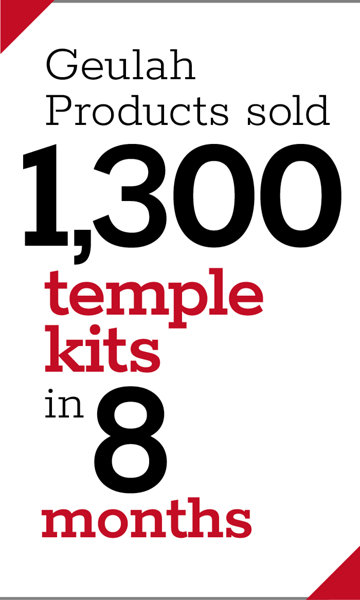
Helinski made the vision a reality. Today, his kits feature elegant design touches, including checkerboard stone floors and a dramatic pillar of fire and smoke rising from the temple’s center. In eight months, Geulah has sold roughly 800 smaller sets (742 pieces) and 500 larger versions (3,480 pieces), a strong showing for a niche religious-educational product.
“The goal is to inspire [Jews] to be more religious and to be more connected, and to care about what God wants from them in their life and why they’re here,” Helinski said.
That inspiration is already taking root. In Miami, fifth-grader Mendel Devlin saved Hanukkah money over several years to buy Geulah’s larger temple kit. He assembled it in just a few days.
“I like that it was actually proportionate,” Mendel said of the kit’s faithfulness to scripture. “I want to design my own [set] of the Third Temple, which is going to be slightly bigger.”
According to prophecy, the real-world Third Temple won’t be built until the coming of the Messiah. But that’s of no concern to Mendel. He’s busily brainstorming and blueprinting so that when that day arrives, he’ll be able to present a fully realized layout of the new temple—captured, not on an ancient scroll, but in the form of a hands-on model made of fun, unbreakable, interlocking bricks.
In an age of split-second attention spans where screens dominate learning, entrepreneurs like Sutton and Helinski have accomplished something quietly remarkable: They have taken a few of the Bible’s most overlooked passages and turned them into a thriving intersection of faith, education and play—one plastic building block at a time.