

He, like three in 10 current cannabis users, couldn’t stop. For five years, his family dealt with Johnny’s paranoia, delusions and psychotic episodes. At age 19, he told his mother, “You were right about the marijuana.... It’s ruined my mind and my life. I’m sorry, and I love you.”
Three days later, he was dead by his own hand.
The odds are increasing that your grade schooler could get addicted to cannabis.
“This is not your Woodstock weed.”
According to a recent report by Children’s National Hospital in Washington, DC, a growing number of children and teens—some as young as 11—are seeking treatment for cannabis use and addiction. The hospital’s addictions program, led by Dr. Siva Kaliamurthy, reports that families are turning to the hospital’s emergency rooms, pediatricians and addiction program clinic as young people struggle with heavy use and related health problems.
If you used marijuana 20 or 30 years ago, you wouldn’t recognize it today. It comes in gummy bears, cookies, candies, lollipops. It appears in vape pens and cartridges that look like innocent highlighters or even video games. A parent could search their child’s room, see the drug and not recognize it. A generation ago, you could identify a user by the distinctive odor on their clothes or in their room. Now, there is no scent.
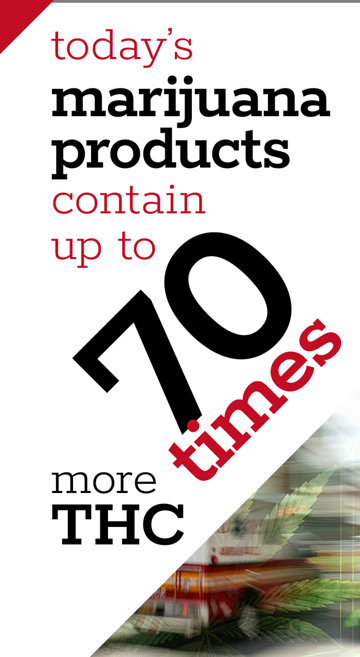
And today, it’s many times more potent. Kaliamurthy said a typical marijuana plant used to contain 1 to 5 percent THC, the chemical that causes a high. Now, many plants are bred to contain 20 to 25 percent THC, and vape pens or cannabis cartridges can contain up to 70 percent.
Dr. Kevin Sabet, former drug policy advisor to three presidential administrations, says some products reach “up to 99.9 percent.”
“This is not your Woodstock weed,” he says.
Delusion, psychosis and addiction—the conditions that drove Johnny to suicide—are just a few of the devastating effects brought on by today’s high-risk cannabis. There’s also cannabinoid hyperemesis syndrome (CHS), characterized by repeated vomiting and abdominal pain, an alarming condition that prompts clinicians to push for better screening and earlier intervention for young users.
The numbers confirm that legalization of cannabis contributes to the spike in sirens and flashing red lights outside ERs across the country. A recent California study of nearly half a million adolescents found that cannabis use was associated with a significantly increased risk of psychosis, depression and other conditions by age 26. A Canadian study comprising 13.5 million individuals went a step further, determining that schizophrenia cases surged with cannabis use—from 3.7 percent before legalization of the drug to 10.3 percent afterward.
When something dangerous becomes legal, it is often falsely perceived as harmless, even normal—a lesson too many are learning too late.
Johnny’s mom now tours the country with her nonprofit, Johnny’s Ambassadors, warning other parents of the dangers of today’s marijuana. When her son first confessed to using it, she scolded him but moved on. “It’s just weed,” she thought. “I used it when I was a girl. I’m fine. It’s no big deal.”
As she and thousands of helpless parents have learned, “It’s no big deal” is how tragedies begin.