

“He sat in a fetal position on the kitchen floor … saying, ‘Help me. Help me. I don’t know what’s happening to me. I am losing my mind. It’s like my head is outside my body looking in.’” —Witness account before an antidepressant user’s suicide
“A total of 22 new psychiatric drugs and supplemental indications were identified,” read the study. “For clinical utility, of drugs with available data, none of them received a rating of ‘clinically helpful,’ and 3/22 (13.6 percent) were rated ‘clinically not helpful.’”
The findings raise a central question: If these drugs provide no measurable benefit, why are they still being approved and sold?
“The findings underscore the need to overhaul psychiatric drug approval standards.”
Jan Eastgate, president of mental health industry watchdog Citizens Commission on Human Rights International (CCHR), summed up the crisis: “The findings underscore the need to overhaul psychiatric drug approval standards and investigate how many Americans have been exposed to unnecessary risk.”
“After decades of rising prescriptions alongside worsening mental health indicators, the evidence reveals a system that is not self-correcting.”
There is a good reason for that: cash.
The psychiatric-pharmaceutical alliance has built a machine that generates tens of billions each year from dangerous drugs that have been proven to cause untold harm for no benefit—even as regulators continue to approve and doctors continue to prescribe them:
- 20–50 percent of patients on antipsychotics suffer from tardive dyskinesia, a potentially permanent movement disorder.
- Nearly half of antipsychotic users and just under half of antidepressant users suffer from abnormal heart rhythms, excessive sedation or serotonin toxicity.
- 56 percent of antidepressant users experience withdrawal effects after stopping the drugs, including surges of anxiety, electric “brain zap” sensations, sudden mood swings—weeping, terror, plunges into “black holes of pure dread”—crippling muscle spasms and suicide.
- Of over 1,000 SSRI patients in one study, 59 percent suffered sexual dysfunctions, including decreased libido, failure to orgasm and genital numbness.
- Of nearly 2,000 antidepressant patients in another study, 47 percent experienced agitation, 60 percent felt emotionally numb and 62 percent reported sexual difficulties. None were warned of the risks of taking the drugs.
- 209,000 deaths annually are associated with psychiatric drug use among the elderly.
The figures are a cannonball to the gut.
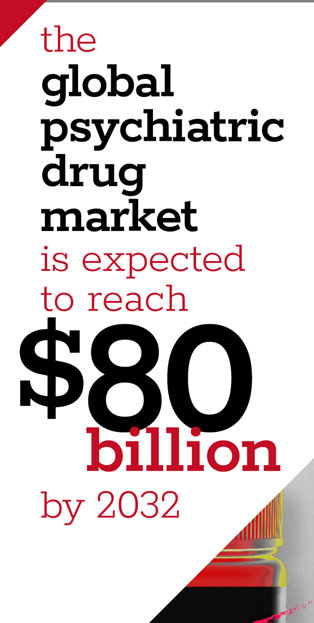
But the only number of importance to the psychiatric-pharmaceutical alliance is 80 billion.
That’s the dollar value the global psychiatric drug market is expected to hit by 2032. If a criminal drug ring needed an incentive not to be “self-correcting,” that figure would surely suffice.
“Repeated safety warnings have accumulated without an effective regulatory response,” CCHR said, referring to so-called “black box” warnings often found on the labels of psychiatric drugs. Brexanolone (Zulresso, an antidepressant), for example, lists “Excess sedation and sudden loss of consciousness,” esketamine (Spravato, an antidepressant) comes with “Increased risk of suicidal thoughts and behaviors” and pimavanserin (Nuplazid, an antipsychotic), is flagged for “Increased risk of death.”
Yet agencies tasked with protecting the public have taken scant action. Meanwhile, psychiatric drugs have become so prevalent and entrenched that their use has now become multi-generational in many families.
As CCHR states: “Allowing high-risk drugs to remain on the market as evidence of harm grows is not precautionary healthcare—it reflects a regulatory failure, imperiling the lives of millions.”