

It seems our side lost.
It’s been four years since New York became the first US city to authorize “safe injection sites,” where junkies can be coddled and assisted in using their illegal substances of choice without fear of arrest.
Located in East Harlem and Washington Heights, the centers provide cozy, sterilized booths that offer privacy for addicts—whether for snorting, smoking or injecting—so they don’t have to face the shame many believe they should feel about their illicit behavior.
Did they die? Did they survive? OnPoint doesn’t even know, because once the ambulance pulls away, they lose interest.
Since 2021, addicts, carrying their personal stashes of heroin, crack cocaine, cocaine or fentanyl, have come to the city-approved shooting galleries (excuse us, the “safe injection sites”) and happily sailed away on their comatose drug trip of choice, secure in the knowledge that if they overdose, there are medical folks close by who will work to save their lives.
The centers even provide—at taxpayer expense—straws for snorting, fresh hypodermic needles for injecting, and oxygen and naloxone to counteract potentially fatal drug emergencies. Helpful aides will even check the drugs beforehand to make sure they’re more or less “safe” to use.
OnPoint, the organization that operates the two sites, brags in large lettering on their office walls, “This site saves lives.”
But does it really?
Dozens of junkies who use the centers—at least 46 in all—have been rushed by ambulance to emergency rooms with life-threatening conditions, including cardiac arrests, strokes or heart attacks.
Did they die? Did they survive? OnPoint doesn’t even know, because once the ambulance pulls away, they lose interest.
Yet the organization brags, “We increased the overall number of visits and frequency of visits to the Overdose Prevention Centers. These are significant successes.”
Yes, they surely are, if you want to make devastating drug abuse easier for addicts to engage in and if you want to convince them they should continue to use the very substances that may bring about their death.
In 2023, 3,156 junkies used the centers 61,184 times, according to OnPoint’s annual report.
Sounds like they have a lot of regular customers.
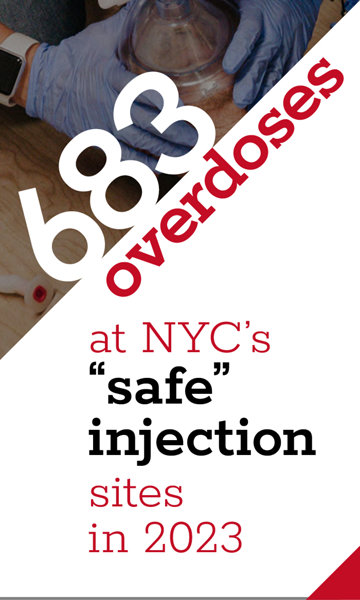
Overdoses at the centers, meanwhile, went up 7 percent, from 636 to 683, between 2022 and 2023.
Some “clients” even used the facilities at least once per day—177 in 2023, to be exact, which is an increase of 108 percent over 2022’s daily visits.
While visiting in 2022–2023, they smoked crack cocaine 56,175 times, shot up heroin 48,714 times, snorted cocaine 30,721 times and injected “speedballs”—the lethal combination of heroin or fentanyl and cocaine that killed Saturday Night Live star John Belushi—19,651 times.
While users were “enjoying” their highs, staff had to intervene in more than 1,700 overdoses.
US Representative Nicole Malliotakis excoriated the “safe injection centers” as “heroin shooting galleries that only encourage drug use and deteriorate our quality of life.”
If addicts continue down their dark road of drug abuse, exactly how is that “harm reduction”?
Anyone with a nickel’s worth of common sense can plainly see that these sites encourage addiction, when what is really needed are increased efforts to stop drug abuse for good.
“The goal can’t simply be to keep people alive,” said former DEA official Jim Crotty. “If you believe, like me, that doing drugs is very destructive, then the goal has to be to stop doing drugs.”
“They’re encouraging people to use by giving them a community center to go to and to use heroin. It’s something that’s encouraging addicts, not helping them,” Representative Malliotakis said.
“Their focus is facilitating drug use, and they don’t think that it is obligatory to try to get people to stop using drugs,” Charles Lehman, public policy expert at the Manhattan Institute, said. “They don’t really care about long-term outcomes.”
The “long-term outcomes” are tragically obvious—“save lives,” yes, for now, but only to give addicts more time to use more drugs and overdose again on the same devastating road to ruin.
The centers are facing the possibility of shutdown from the administration’s “Ending Crime and Disorder on America’s Streets” order, which directs the federal government not to fund so-called “harm reduction or safe consumption efforts” that “only facilitate illegal drug use and its attendant harm.”
By the way, if addicts continue down their dark road of drug abuse, exactly how is that “harm reduction”? If they have to be dragged back, again and again, from the very brink of the abyss of death, how does that constitute “safe consumption”?
Representative Malliotakis asked the Department of Justice “to take immediate action and shut down these centers and put an end once and for all to their operations.”
“They don’t work, these heroin injection centers,” she said. “In fact, they attract crime to the neighborhood but also drug dealing. It just does not make sense and they should be shut down.”
The United States is far from alone in harboring “drug consumption rooms”—in fact, there were over 100 such centers in Europe, Australia, Canada and Mexico as of 2022.
But like your mama said, just because everyone is doing it, that doesn’t mean you should, or that it’s right.
“They’ve continued to do something that doesn’t work at greater scale,” Lehman said. “That’s nice, but there’s no measure of outcomes, which doesn’t surprise me, because the outcomes will not look good.”
What does look good? Education, to inform people of the bitter truths about drug abuse and help them prevent addiction before it ever starts.
To that end, the Church of Scientology sponsors the largest nongovernmental drug education and prevention campaign on Earth, the Truth About Drugs.
To date, 170 million educational booklets have been distributed and hundreds of thousands of youth have been prevented from a life of addiction thanks to the program, which has been used by more than 1,000 law enforcement agencies and is praised by educators and government officials across the globe.
There is no question about it, so-called “harm reduction” doesn’t work.
Education is the most effective weapon we have in the war against drug abuse.