

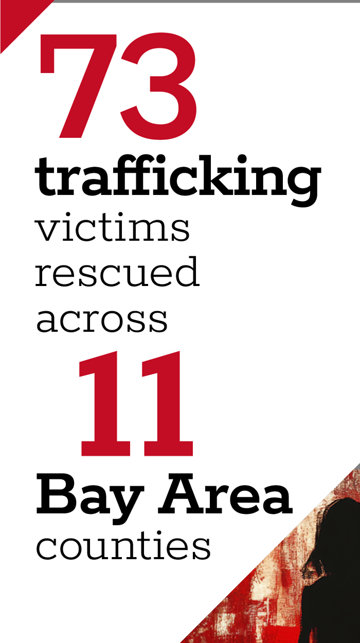
Across 11 Bay Area counties, a coordinated anti-trafficking campaign led to 29 arrests and the recovery of 73 sex trafficking victims, including 10 minors. One of those victims—a 12-year-old—had been trafficked in Oakland.
“For traffickers that still came to the game from all over the world with bad intentions, many ended up behind bars.”
Released February 19 by the Santa Clara County District Attorney’s Office, the figures capture two weeks of intensified enforcement surrounding one of the world’s largest sporting events. Beyond the arrest totals, authorities say the operation functioned as a regional proving ground: a test of whether real-time data analysis and cross-county coordination can reduce the exploitation risks that accompany global spectacles and the influx of visitors and money they bring. That model is now being positioned for reuse during the 2026 FIFA World Cup games scheduled at Levi’s Stadium from June 13 to July 1.
District Attorney Jeff Rosen framed the effort as a demonstration of interagency unity. “Beyond football, the Super Bowl was a triumph of Bay Area law enforcement planning, organization, cooperation and safety,” he said. “Close to 70 agencies effectively discouraged traffickers from exploiting the game and victims. For traffickers that still came to the game from all over the world with bad intentions, many ended up behind bars.”
The Human Trafficking Task Force, led by Lieutenant Joshua Singleton, coordinated those nearly 70 agencies, stretching from Sacramento to Monterey. For two weeks prior to kickoff, analysts staffed a centralized command post in Sunnyvale alongside federal partners, the Santa Clara County Sheriff’s Office, the District Attorney’s Crime Strategies Unit and nonprofit organizations including In Our Backyard and the National Center for Missing & Exploited Children.
Tips were processed in real time, intelligence packets were transmitted directly to officers in the field, and nearly 40 operations were launched in timeframes that officials said would ordinarily require weeks.
“There was a suite of over 20 different analysts … that were all providing real time intelligence packets that we were disseminating out into the field to our law enforcement partners. Never been done before,” Singleton told ABC7.
The enforcement footprint spanned the region. Investigators rescued 20 victims in San Mateo County and 17 in Contra Costa, where seven traffickers were taken into custody. Monterey and Solano counties added six more arrests, while Santa Clara saw seven victims freed, two traffickers jailed and a firearm seized—underscoring the operation’s reach and impact.
“Ultimately human trafficking can happen anywhere and oftentimes it happens right underneath the public eye, and they are not even aware of it,” Singleton said.
Among the 73 survivors, the youngest was 12 years old—a recovery Singleton described as “extremely tragic.”
Despite the arrests and rescues, authorities urged caution in interpreting the data, noting that the link between major sporting events and trafficking is complex. Singleton said there have not been “any prevalent studies” establishing a causal link, adding that it remains unclear whether the increase reflected the Super Bowl itself or the coordinated effort by the task force, social workers and partner agencies during that period.
For those recovered, law enforcement involvement marks only the start of a longer stabilization process. Community Solutions’ Director of Domestic Violence, Sexual Assault and Human Trafficking Programs Perla Flores described a phased response that begins with urgent needs: “The focus at the beginning is, what are the basic emergency needs? Do you have shelter? Do you have food? Do you have clothing? Do you have access to urgent medical care? … Then, once those pieces are addressed, which sometimes can take 30 days, it could take 60 days, then we develop a plan for long-term support.”
Criminal prosecution presents additional challenges. San Mateo County District Attorney Steve Wagstaffe told ABC7 that his office had received two cases stemming from the operation and filed charges in both.
“We need two things. We need evidence that shows the trafficker committed the crime and number two we need a cooperative victim. That is the difficulty,” Wagstaffe said. He added that, where evidence and cooperation align, traffickers could face sentences ranging “between 15 to 20 years to up to life in prison.”
With the Super Bowl concluded, the same infrastructure is now being redirected toward the 2026 FIFA World Cup, which will bring matches to Santa Clara as well as cities across the United States, Canada and Mexico. Levi’s Stadium is slated to host six games, while Southern California’s SoFi Stadium will host eight.
“The Super Bowl provided opportunities for increased awareness partnerships with analysts from various law enforcement agencies including prosecutors and community-based organizations,” Singleton said. “We are already working with other local, state and federal analysts to prepare for the upcoming World Cup.”
Officials acknowledge that sustaining such an intensive, multi-agency model will test budgets and staffing, especially once media attention shifts elsewhere. Yet the Super Bowl mobilization offered a tangible demonstration of what regional intelligence fusion can produce when agencies act from a shared command structure.
If February’s results serve as precedent, the next challenge is not whether agencies can mobilize, but whether they can sustain that vigilance long after the stadium lights dim.