


Officials hailed the action as a decisive blow against a digital marketplace that enabled the large-scale sale of women and children for sex. Yet eight years later, the site is gone, but the system it exposed was never fully dismantled.
If Epstein embodied the spectacle of trafficking, Backpage built the infrastructure that enabled and sustained it.
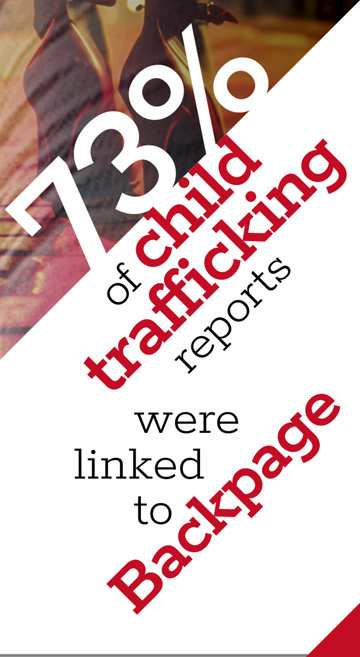
For roughly 14 years, Backpage operated on a massive scale, processing millions of ads annually and generating hundreds of millions in revenue. A 2017 Senate subcommittee investigation reported that 73 percent of all child trafficking reports received by the National Center for Missing and Exploited Children were linked to the site.
Yet then Village Voice editor Tony Ortega shockingly boasted: “The people I work for were smart enough to start Backpage.com,” collapsing any distance between himself and the child trafficking platform. “Yes, we take 30 million ads a year from users at our Backpage.com website,” he proudly wrote.
That posture was consistent with Ortega’s broader public defense of the site. As part of a sustained campaign that earned him the label of Backpage’s “attack dog” from The New York Times, Ortega repeatedly minimized child sex trafficking as “a mass panic,” “national fantasy” and “small problem,” while targeting those exposing what he called a “nonexistent epidemic of sexual slavery.” In one column, Ortega insisted that underage prostitution “is nothing like what is being trumpeted ... by activists who want to put us out of business,” dismissing the scope and severity of the exploitation in plain sight.
Backpage’s subsequent seizure marked a rare moment when the machinery of online trafficking was exposed and disrupted. Yet what followed was prosecution focused on a handful of executives while leaving the wider network of actors who enabled, defended or benefited from the platform largely untouched.
Eight years on, Jeffrey Epstein offers a useful parallel. His crimes captured global attention, in part because of the prominence of those associated with him. His prosecution—and the continued scrutiny of his associates—created the impression of a widening circle of accountability. Yet the structural dynamics of trafficking did not begin or end with Epstein, nor were they confined to elite social networks or private islands.
Backpage operated at far greater scale and in plain sight—but with much less enduring public interest. It normalized exploitation through a sex trading platform accessible to anyone with an internet connection, transforming what had once been hidden markets into a nationwide, even global system.
If Epstein embodied the spectacle of trafficking, Backpage built the infrastructure that enabled and sustained it. It diffused responsibility across layers of actors, making it easier for many to remain in the background—even when their roles, like Tony Ortega’s as “attack dog,” were essential to the operation.
Against that backdrop, the federal government’s Backpage restitution program—funded by more than $200 million in seized assets and subject to a recently passed March 31 filing deadline—stands as the largest victim compensation effort tied to a trafficking case in US history. It offers a measure of redress to survivors, yet it also underscores a fundamental limitation, addressing harm after the fact, even as many victims—burdened with prostitution-related arrest records from their exploitation—remain shut out of stable employment, while the broader network of responsibility remains unaddressed. The victims were stigmatized, while many of their victimizers remain untouched.
What has changed since 2018 is, in many ways, technological rather than structural. Online platforms have evolved, moderation practices have shifted and law enforcement has adapted to new digital environments. What hasn’t changed is the underlying demand, the profitability of exploitation and the ease with which sex trafficking operations migrate across jurisdictions and platforms.
With the seizure of Backpage announced eight years ago today, a single platform was shut down and a specific set of actors was prosecuted.
But until the people who made Backpage and its brethren possible are brought to view and held to account, the story doesn’t end with a seizure. It continues, less visibly but no less persistently, where exploitation, profit and silence still converge, and in the lack of accountability for those who helped sustain it—figures like Tony Ortega, who have yet to face any legal consequence.