

He seems terminally sad—a permanent confusion on his face that never quite goes away.
It wasn’t always like this. Jose was a dark-haired, vibrant man with sharp, alert eyes and a ready smile—a California state tax auditor with happy children, who built a loving home in Auburn and a good, fruitful life.
But when he became depressed, he wanted to bring his old sparkle back and make his smile glow brighter again.
He turned to a facility which, to this day, offers “treatment” with electroconvulsive therapy (ECT), also known as electroshock.
It was the worst decision of his life.
Jose remembers nothing. Not his wife, not his children, not his parents or siblings.
The psychiatric industry insists that ECT is safe, but common sense says it is anything but. Blasting brains with up to 460 volts of electricity far too often ends in tragedy.
“My husband Jose Topete had ECT. They told us what a great thing it was and how it was going to help our family and help Jose,” Margaret said. But over the course of 23 sessions, she explains, “he did not get better at any time.”
“We didn’t realize that his whole memory was gone until after ECT was over.”
Jose remembers nothing. Not his wife, not his children, not his parents or siblings.
His mind was erased. He is still breathing, but the man he was is gone.
“One of the just terrible times was, we live in a rural area that has a pond,” Margaret explains. “We have lots of frogs and bullfrogs. Well, we heard the frogs making a lot of racket and Jose said, ‘What’s that noise?’
“And we said, ‘Oh, it’s just the frogs.’”
“What’s a frog?” he replied.
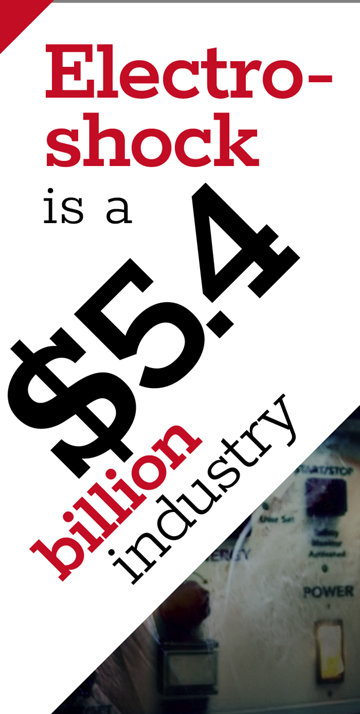
The same psychiatrists who have built a $5.4 billion empire out of ECT claim the procedure is harmless. And the regulatory system helps keep their empire intact. ECT machines are currently rated by the FDA as a “Class II” device, a category that allows them to remain on the market without the kind of safety and efficacy testing the risks demand.
Items under Class II include electric wheelchairs, syringes and contact lenses, even condoms.
Unlike those items, ECT machines have been known to cause strokes, catatonia and death, and have even set a patient’s head on fire.
Does that sound safe and effective to you?
“There is nothing else in Class II that causes brain damage, cardiac standstill, stroke, brain hemorrhage, seizures,” Dr. Moira Dolan said. “The reason they want to put the ECT machine in Class II is because it wouldn’t have to be tested for safety or effectiveness.”
“I spent a lot of time and money on education because I wanted to be smart [but] I don’t remember anything anymore.”
Jan Eastgate, president of Citizens Commission on Human Rights International, said, “Despite tens of thousands of people saying electroshock is damaging, that it can actually kill you, that it destroys [your] life,” ECT still remains in use—with 100,000 Americans receiving electroshock every year.
It certainly destroyed Jose’s life, turning him into an addled stranger to everything he once held dear. He now spends his days staring in confusion and trying to comprehend the world around him, unable to grasp what happened to his life and his memory.
His case is tragically similar to that of Carol, a young girl who underwent ECT. “I’m stupid now,” she says. “I spent a lot of time and money on education because I wanted to be smart [but] I don’t remember anything anymore.… When it came to ECT, it was out of sheer desperation.”
“I didn’t research it,” she adds. “I just trusted. And now that I’m where I am, I don’t have the brain capacity to research it. It’s too late.”
Like other psychiatric tortures—boring holes in the skull; purging and bloodletting; isolation and abuse; frontal lobotomy and massive dosages of zombifying drugs—it’s time for ECT to be relegated to the history books alongside psychiatry’s most infamous abuses.
It’s time for ECT to disappear, for good.
“Everything was wiped out of his mind,” Margaret said. “His children, me. He didn’t know who we were.
“At first I thought, ‘Okay, we’ll be able to just teach him who we are and make him love us again.’ And it didn’t work like that.
“It’s been a real heartbreak for all of us.”