

And that would mean the end of our democracy.
Dr. David Cuillier, director of the Freedom of Information Project, Brechner Center for the Advancement of the First Amendment at the University of Florida College of Journalism and Communications, is a leading authority on the Freedom of Information Act (FOIA) and the dangers facing it.
“You can’t have democracy if you have secrecy. It just doesn’t work.”
In an exclusive interview with Freedom Magazine, he said: “I think we are in a period of human history, around the world, where governments are becoming more closed off, secretive and authoritarian.
“The shining beacon of democracy that used to hold a lot of promise is weakened. It is dimming and I am concerned about it.
“You can’t have democracy if you have secrecy. It just doesn’t work.”
His concern stems from a weakening of federal, state and even local FOIA systems, which once promised relatively easy access to public information, but which have increasingly encountered strong resistance from entrenched bureaucrats—bureaucrats who are often anxious to protect their administrative fiefdoms from citizens seeking to discover what their government is up to.
As a result, such bureaucrats have developed an array of methods to stiff-arm requests for information, including charging excessively high fees for research and copying; “slow-rolling” responses by releasing only small portions of records at a time; issuing “Glomar” responses in which officials state they can “neither confirm nor deny” the existence of the requested information; or simply taking eons to answer—often in the hope that the requester will give up or lose interest.
“Police departments do it all the time,” Dr. Cuillier told Freedom. “They are traditionally some of the most secretive agencies out there, followed only by public universities and national security agencies.”
Dr. Cuillier gave a striking example: “The ‘personnel’ exemptions that you see floating around the country are often abused. They will label anything as ‘personnel,’ including the name of the person, or their office phone number. That’s not a ‘personnel’ issue. We deserve to know if public employees committed fraud or terrible acts.
“You can’t hide that behind ‘personnel’—and yet they do it all the time.”
The problem, he explains, is that FOIA laws run counter to human nature. “It’s the nature of government—the default is secrecy and information control,” Dr. Cuillier said. “Any group of humans who get together want to control information. They want to avoid bad stuff getting out.
“That’s why we have laws to try to get them to override that tendency.”
And with good reason. “We the people have to know what the government is doing in order to be in charge and to know who to boot out of office,” he said. “People who are being watched are on better behavior.
“Almost all state laws have penalties for government breaking the law,” he continued. “But as far as I know, they were enforced only once, in Atlanta, Georgia, several years ago, when a civil employee was prosecuted for violating the open records law.
“So you really don’t have penalties. If there are no penalties, why not break the law?”
For that reason, Dr. Cuillier favors stricter enforcement of existing FOIA statutes. He also advocates for a constitutional amendment—a kind of overall FOIA that would apply across the nation at the federal and state levels.
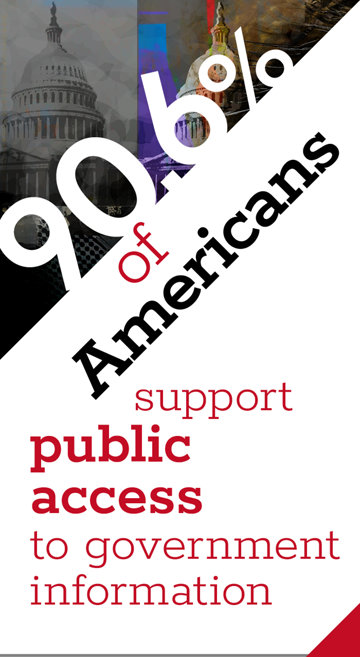
In a recent survey the Brechner Project did of 1,000 Americans, some 90.6 percent said they’re in favor of public access to government information. But 91.9 percent have never used FOIA.
“Two-thirds of public record requests are submitted by corporations,” he explained. The average citizen doesn’t “realize the importance of these records in everyday life, [so] I understand why most people aren’t grabbing their pitchforks and torches to demand transparency.
“But information greases our economic machines and without it, we would all fall apart. You don’t see this because it’s behind the scenes. You don’t miss it until it’s gone.
“Unfortunately, it may all be gone someday.”
That concern over secrecy has not been limited to academics and policy experts. The Church of Scientology is one of the fiercest and most dedicated advocates of freedom of information. Scientology Founder L. Ron Hubbard himself said, “Democracy depends exclusively on the informedness of the individual citizen.”
Dr. Cuillier agrees.
“We are in a terrible situation. I can’t emphasize enough the danger we are in as a nation.
“Lawmakers aren’t going to change it unless we demand it.”
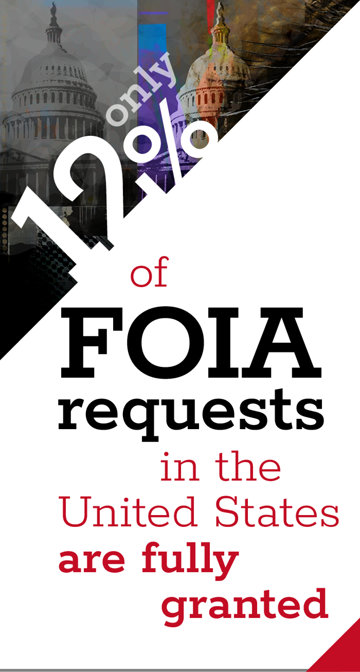
Dr. Cuillier says the “secrecy creep” has been going on for the past three decades. Today, only about 12 percent of FOIA requests are fully granted, and Dr. Cuillier expects that figure to drop to 11 or 10 percent when the newest statistics emerge.
“It gets worse all the time,” he said. “I see no sign of it changing.”
“What happens when it gets to zero?”
David Cuillier is director of the Freedom of Information Project, Brechner Center for the Advancement of the First Amendment at the University of Florida College of Journalism and Communications. A leading authority on freedom of information, he serves on the federal FOIA Advisory Committee, is a past president of the National Freedom of Information Coalition and has testified before Congress three times on FOIA.
Over the past two decades, Cuillier has trained more than 10,000 journalists, students and citizens on how to obtain public records, and is coauthor of The Art of Access: Strategies for Acquiring Public Records and Transparency 2.0: Digital Data and Privacy in a Wired World.
He is also a past national president of the Society of Professional Journalists.